Selective Gluteal Myomodulation®

Male Buttock Feminization

FEMINIZATION DOES NOT MEAN FEMINIZING EVERYTHING.

Myomodulation® makes it possible to select which components of gluteal geometry should change — and which anatomical features should remain intentionally masculine.

SELECTIVE MORPHOLOGY
Lateral contour, projection, infragluteal architecture and intergluteal geometry can be planned independently, according to the patient's individual aesthetic objective.
Lateral Contour
Projection
Infragluteal Architecture
Intergluteal Geometry
Male buttock feminization with selective gluteal contour reshaping
Patient-Defined Morphology Modify the desired anatomical features. Preserve the others.
Clinical Overview

In 30 Seconds

NOT A PREDEFINED FEMALE SHAPE

Male buttock feminization can be selective and anatomically targeted. The treatment plan depends on which morphological features the patient wants to modify — and which features should be preserved.

01

Lateral Contour

The external concavity or hip dip can be reduced by changing the directional action of the lateral gluteal tensors.

Shape
02

Projection

When lateral width changes, projection may need to be rebalanced to preserve a coherent three-dimensional gluteal contour.

3D Balance
03

Infragluteal Architecture

The contour below the gluteal fold can be considered separately when the patient wants a different lower-buttock silhouette.

Lower Contour
04

Intergluteal Geometry

Intergluteal morphology is another independent variable. It may be modified or deliberately preserved according to the treatment objective.

Preserve or Modify
4
One Buttock — Four Independent Decisions

Feminization may involve one, several, or none of these components. The objective is not to impose a gender template, but to construct the morphology requested by the patient.

Explore This Clinical Guide

Clinical Roadmap

FROM MORPHOLOGICAL ANALYSIS TO SELECTIVE THREE-DIMENSIONAL RESHAPING.

Navigate the principles, anatomical targets, planning logic and clinical application of selective male buttock feminization with Myomodulation®.

The Clinical Pathway
ANALYZE → SELECT → PRESERVE → REBALANCE → RESHAPE

One anatomical framework. Three selective feminization targets. Patient-defined three-dimensional morphology.

Clinical Definition

What Does Male Buttock Feminization Mean?

A direction of reshaping — not a standardized anatomical endpoint.
Male gluteal morphology illustrating selective buttock feminization
Morphology Before Labels

The treatment plan begins with anatomical objectives, not assumptions about the patient.

A SELECTIVE MORPHOLOGICAL CONCEPT

Male buttock feminization means modifying selected characteristics of gluteal shape toward a morphology perceived by the patient as more feminine, while other characteristics may remain unchanged. It does not require transformation of the entire buttock.

01

SELECT THE TARGET

The request may concern lateral contour, projection, the infragluteal region, intergluteal geometry — or a combination.

02

PRESERVE WHAT MATTERS

Features that the patient does not wish to feminize remain part of the planned morphology rather than being changed automatically.

03

REBALANCE THE WHOLE

A local change can alter global proportions. Projection and contour therefore need to remain coherent in three dimensions.

IT IS NOT

A predetermined “female buttock” imposed identically on every male patient.

IT IS

A patient-defined selection of morphological changes translated into an anatomical treatment plan.

The Clinical Principle

Gender identity and sexual orientation do not define the treatment pattern. The relevant clinical question is which anatomical characteristics the patient wants to modify, enhance or preserve.
Morphological Analysis

Masculine vs Feminized Gluteal Geometry

Feminization is not defined by one shape — it results from changing selected geometric relationships.
3D Gluteal Geometry
Three-dimensional analysis of male buttock geometry and maximum projection
Geometry Before Treatment Width, lateral contour, projection and lower gluteal architecture must be interpreted together rather than as isolated measurements.

FROM SEX-BASED LABELS TO GEOMETRIC VARIABLES

A buttock may appear more masculine or more feminized through the relationship between several morphological parameters. Myomodulation® allows these parameters to be considered selectively rather than treating “feminization” as one indivisible procedure.

01

LATERAL WIDTH

A straighter or more concave lateral contour can be shifted toward a rounder external silhouette when this is part of the patient's objective.

02

EXTERNAL CONCAVITY

The lateral depression or hip-dip region is a distinct geometric variable and can be reduced without redesigning the entire buttock.

03

MAXIMUM PROJECTION

The position and magnitude of maximum projection influence the three-dimensional impression of the buttock and may require rebalancing after lateral reshaping.

04

INFRAGLUTEAL CONTOUR

The lower transition of the buttock contributes to apparent height, leg-to-buttock proportion and the visual termination of the gluteal volume.

05

INTERGLUTEAL GEOMETRY

The intergluteal cleft represents another independent morphological component. In selective feminization, it may be modified, left unchanged, or deliberately preserved according to the patient's request.

Morphology Is a Spectrum
More Masculine Geometry More Feminized Geometry
3D
The Planning Principle

The objective is not to move every patient toward the same endpoint. It is to identify which geometric variables should move along the spectrum — and which should remain exactly where they are.

Tenenbaum–Tiziani Vector–Tensor Model

Vector & Tensor-Based Myomodulation®

DECOMPOSE THE VOLUME. TRANSFORM EACH UNIT. RECOMPOSE THE SHAPE.

In the Tenenbaum–Tiziani model, the gluteal volume is conceptually decomposed into smaller three-dimensional volumetric units. Each unit can then be considered locally through the interaction of a vector and a tensor before the individual transformations are integrated into the resulting global three-dimensional morphology.

THE SURFACE GRID REPRESENTS AN UNDERLYING 3D VOLUMETRIC MODEL

The visible squares are not treated as isolated two-dimensional surface areas. They provide a clinical representation of smaller volumetric units within the larger gluteal volume.
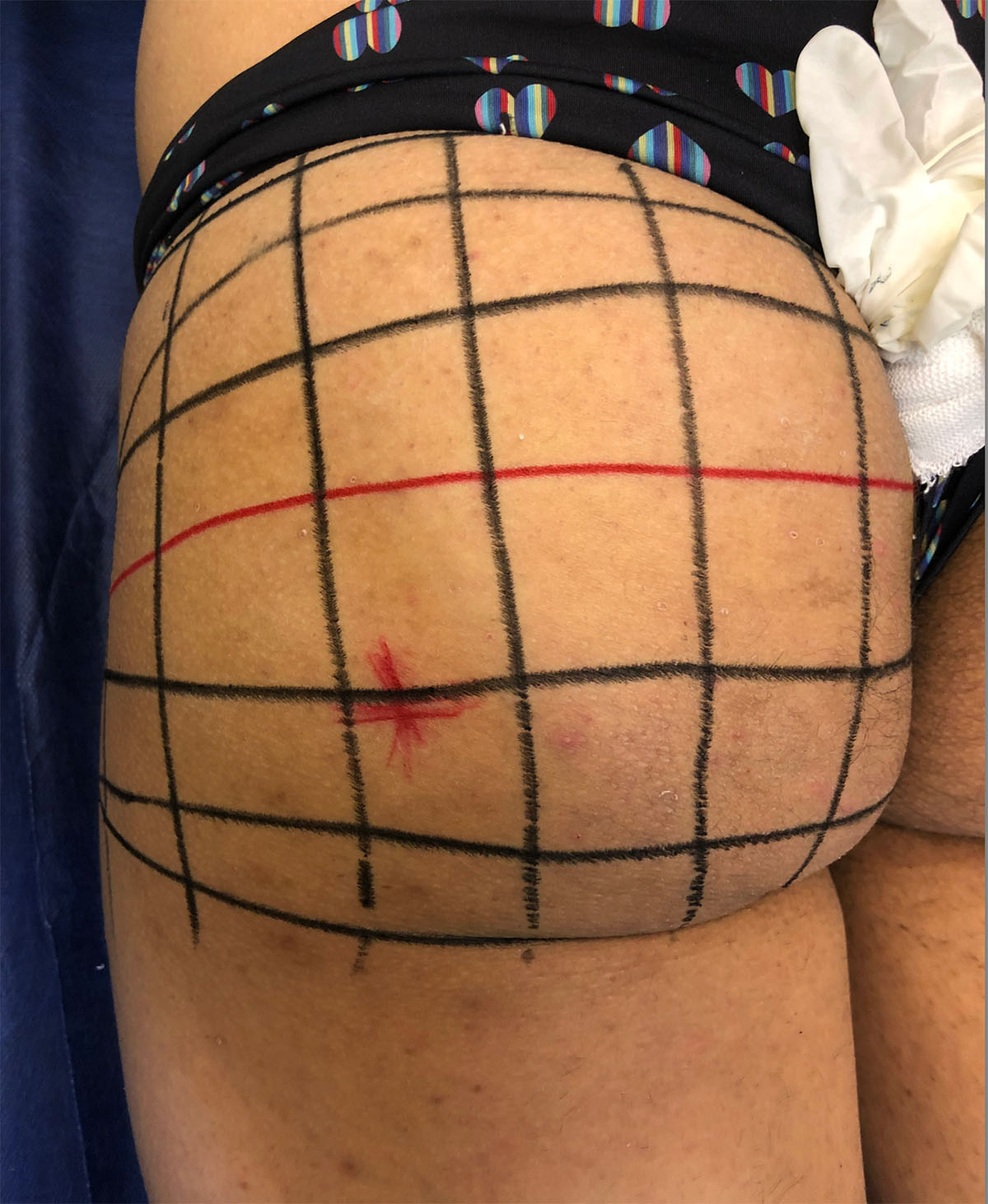
Male gluteal volume divided into a clinical grid representing three-dimensional volumetric units
Clinical representation of volumetric decomposition
01
Volume Decomposition

From One Large Volume to Local Units

A buttock is a large three-dimensional anatomical volume. To plan a controlled change of shape, the volume is conceptually subdivided into smaller volumetric units. This makes it possible to consider different local transformations within different territories of the same buttock.

The grid is a planning representation: the therapeutic concept concerns the three-dimensional volume underlying each visible surface unit.
02
Spatial Organization

Building the Volumetric Map

Longitudinal treatment columns and transverse treatment levels create a reproducible spatial framework. Their intersection provides the surface representation used to localize the volumetric units on which vector–tensor planning is applied.
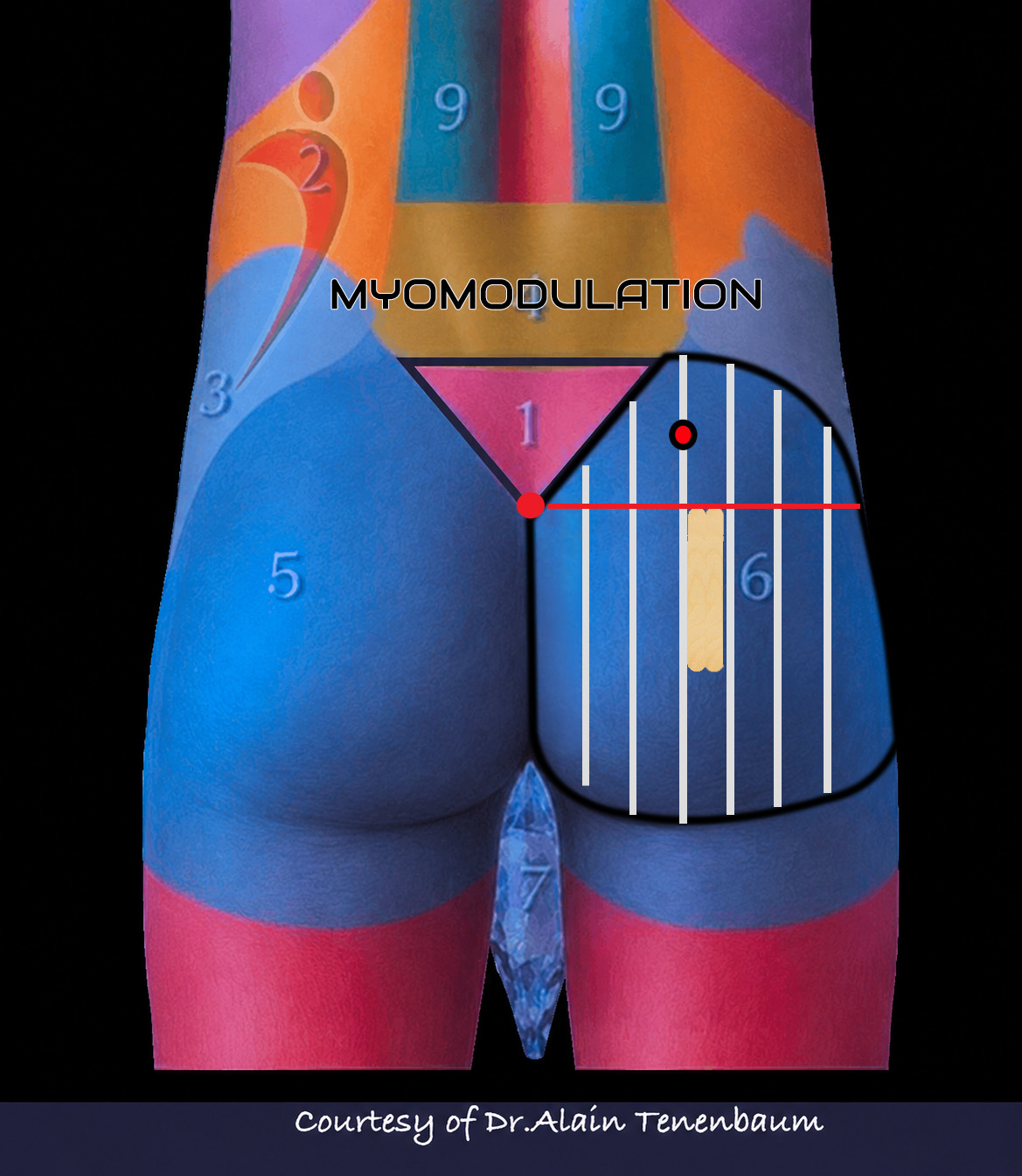
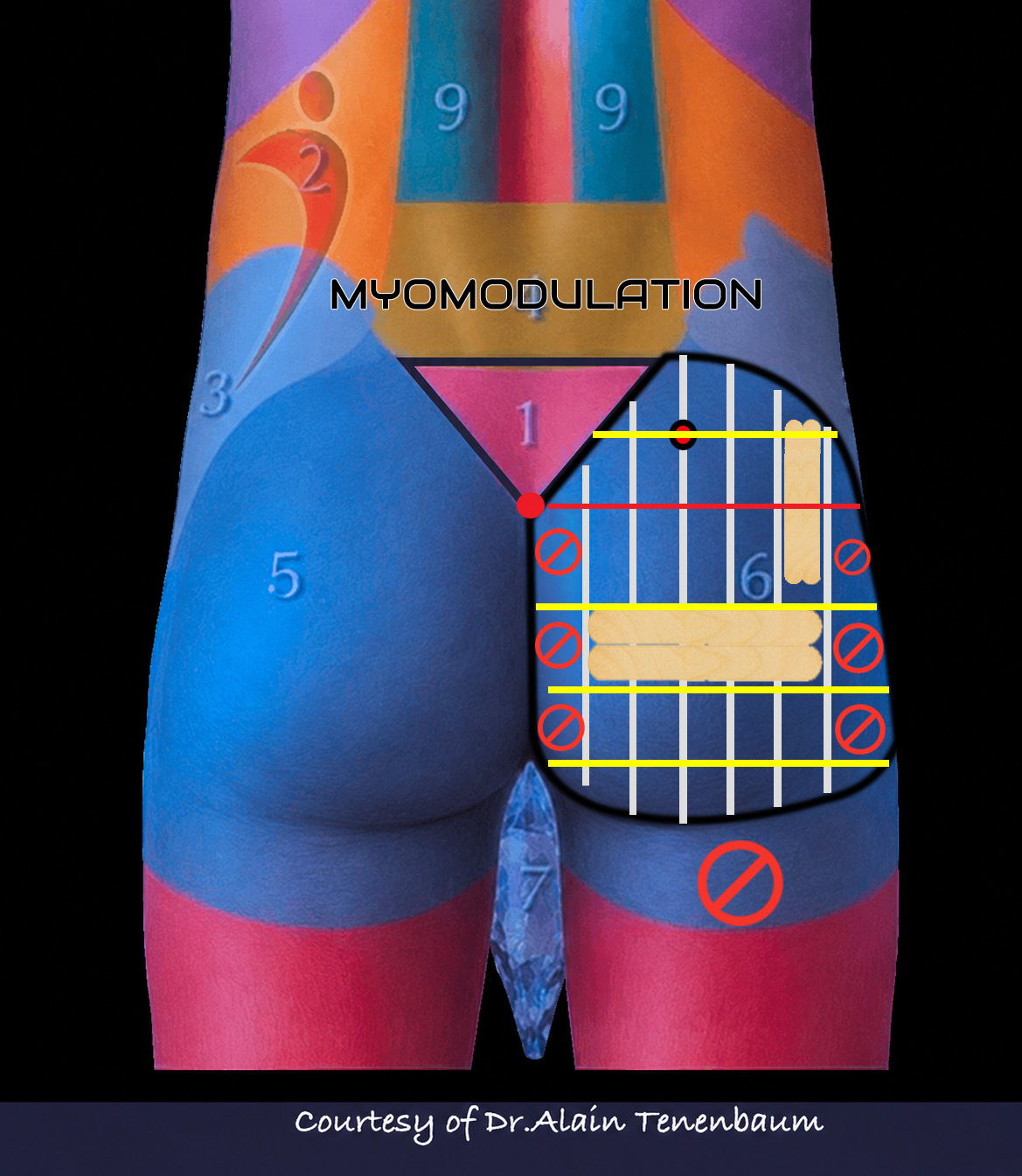
The purpose is not to create identical squares, but to establish coordinates for controlled local transformations throughout the gluteal volume.
Longitudinal treatment columns used in male gluteal mapping
Longitudinal Columns
Transverse treatment levels completing male gluteal volumetric mapping
Transverse Levels
⊘
READING THE MALE TREATMENT MAP

The following diagrams show the standard Myomodulation® treatment pattern for male buttocks. Areas marked with the red barred-circle symbol identify the specific territories to be modified when feminization is requested. The remaining mapped areas correspond to standard male buttock reshaping without feminization.
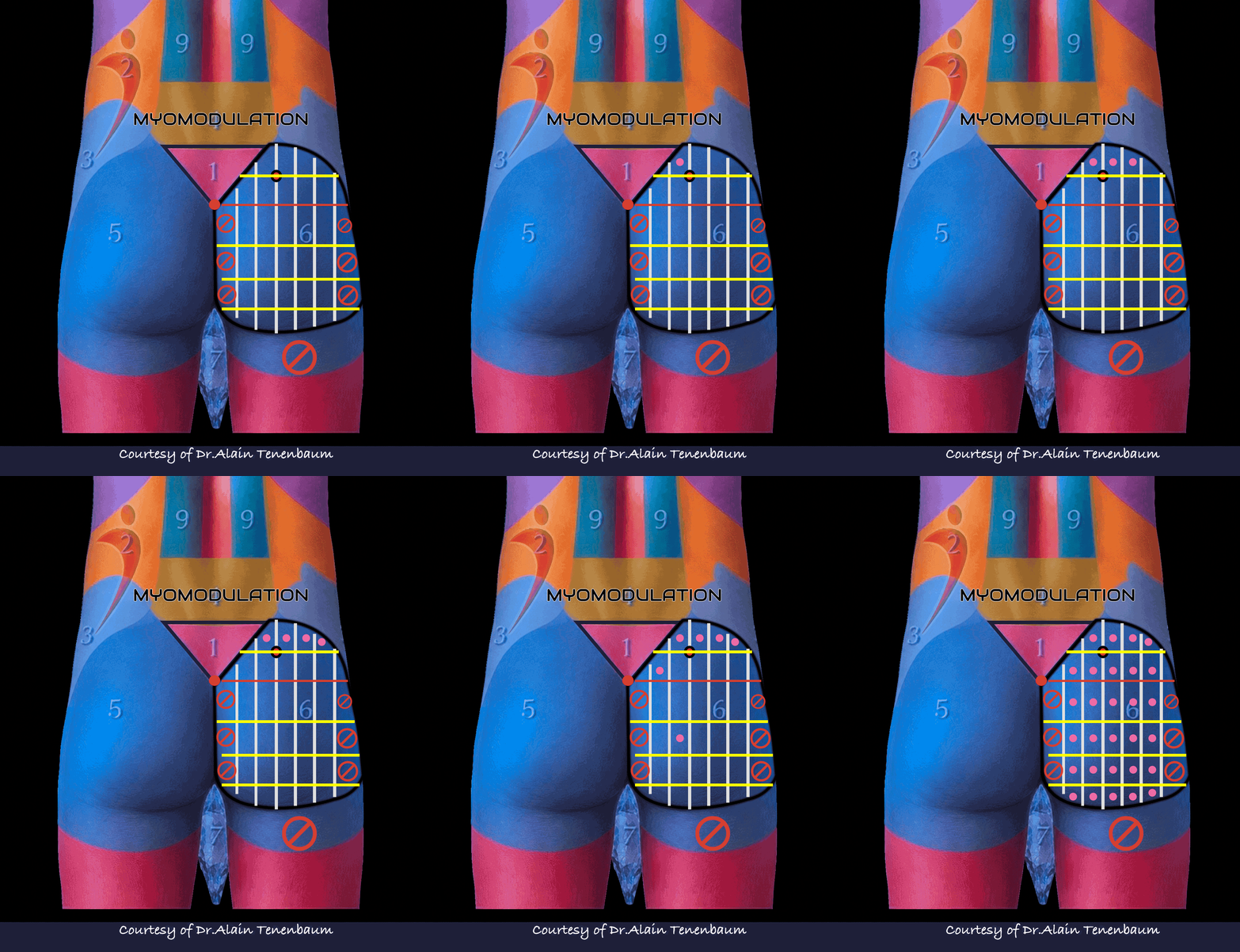
Animated male gluteal vector design showing standard male treatment mapping and feminization-specific territories
Vector Design — standard male mapping with feminization-specific territories marked ⊘
03
Local Vector

Select the Vector for Each Unit

Within each volumetric unit, a vector constitutes the first component of the local vector–tensor transformation. Vector selection can therefore vary from one unit to another according to the intended regional reshaping strategy.

A complex buttock transformation does not require one single global vector. Different volumetric units can participate differently in the final morphology.
04
Local Tensor

Apply the Directional Matrix

A tensor is then assigned to the same volumetric unit. In the Tenenbaum–Tiziani model, the tensor represents the matrix governing the directional transformation associated with that local unit.
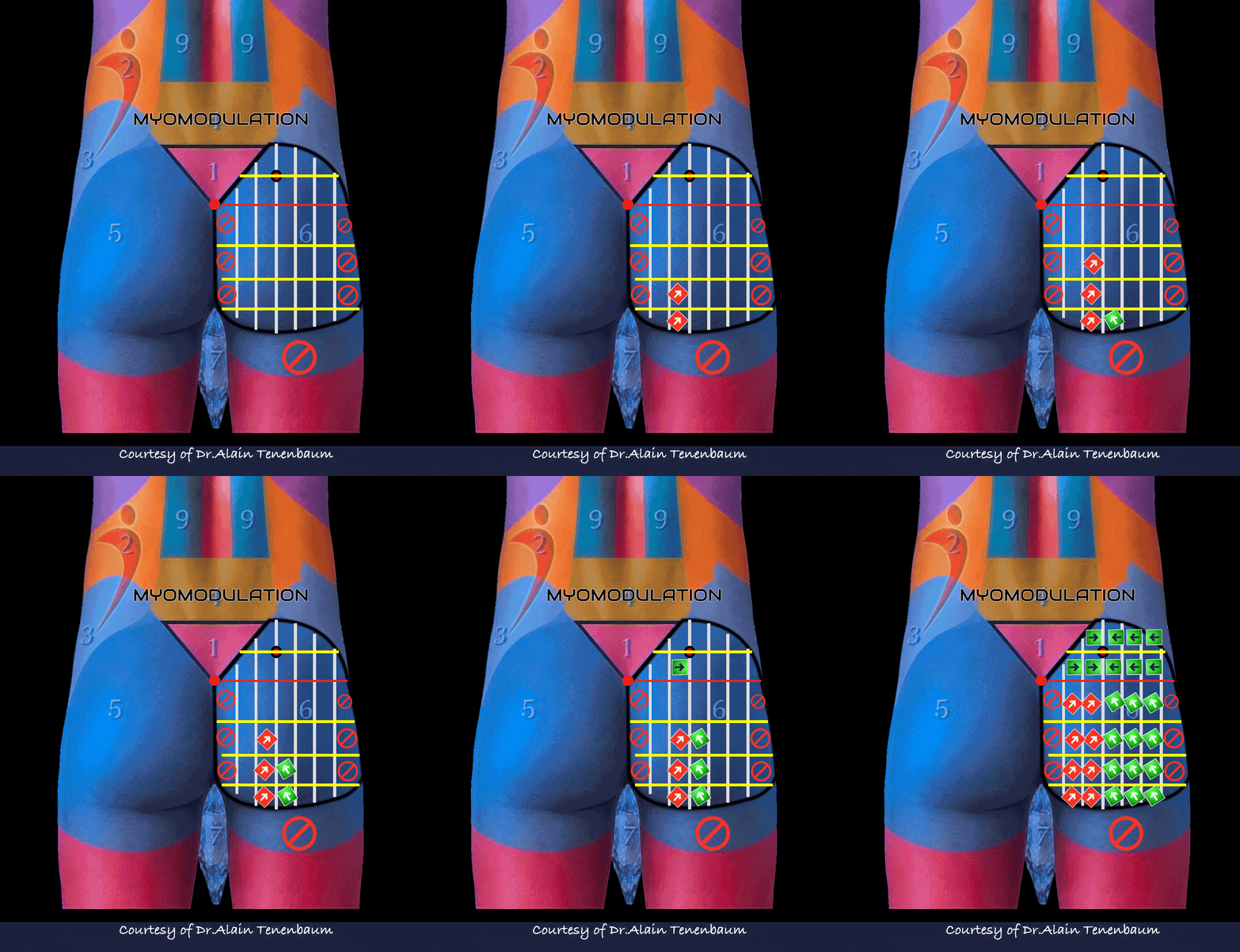
The tensor is therefore not an interchangeable synonym for the vector: the two components have distinct functions within the local transformation.
Animated male gluteal tensor design showing standard male treatment mapping and feminization-specific territories
Tensor Design — standard male mapping with feminization-specific territories marked ⊘
Local Transformation
Vector First component selected for the volumetric unit
×
Tensor Directional matrix applied to the same unit
→
Local 3D Transformation Resulting transformation of the individual volumetric unit

The Vector × Tensor interaction defines the transformation of the individual volumetric unit. By varying these local transformations across the mapped gluteal volume, different components of contour and projection can be selectively reorganized.

05
Clinical Translation

From Vector–Tensor Design to Injection

The two components of the model remain distinct during clinical translation. Vector planning and tensor planning each have their corresponding injection pattern. Their combination translates the local Vector × Tensor architecture into the treatment strategy.
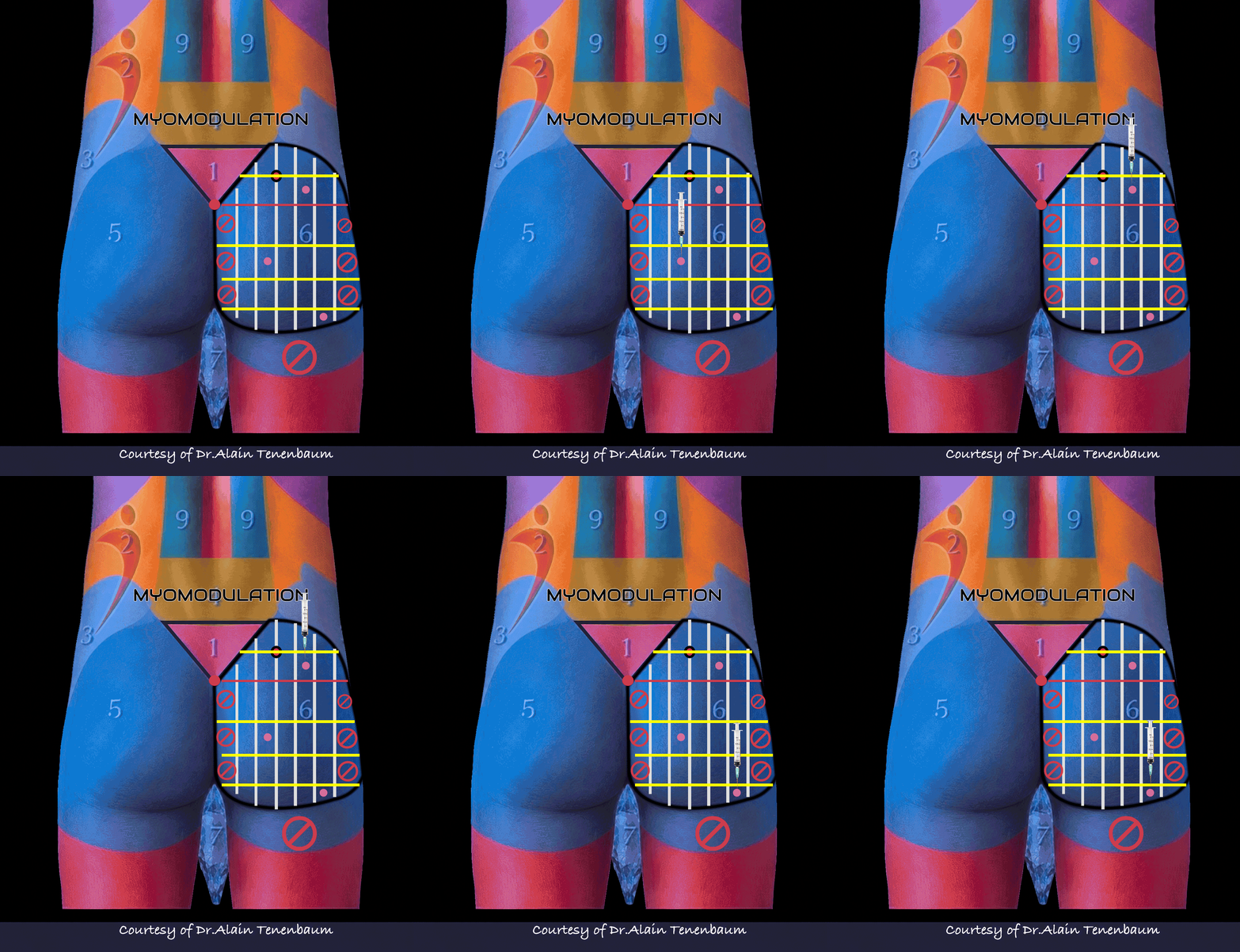
VECTOR APPLICATION
Animated clinical application of vector injections in male gluteal Myomodulation
Vector Design → Vector Injection

The selected vector component is translated into its corresponding local injection pattern.
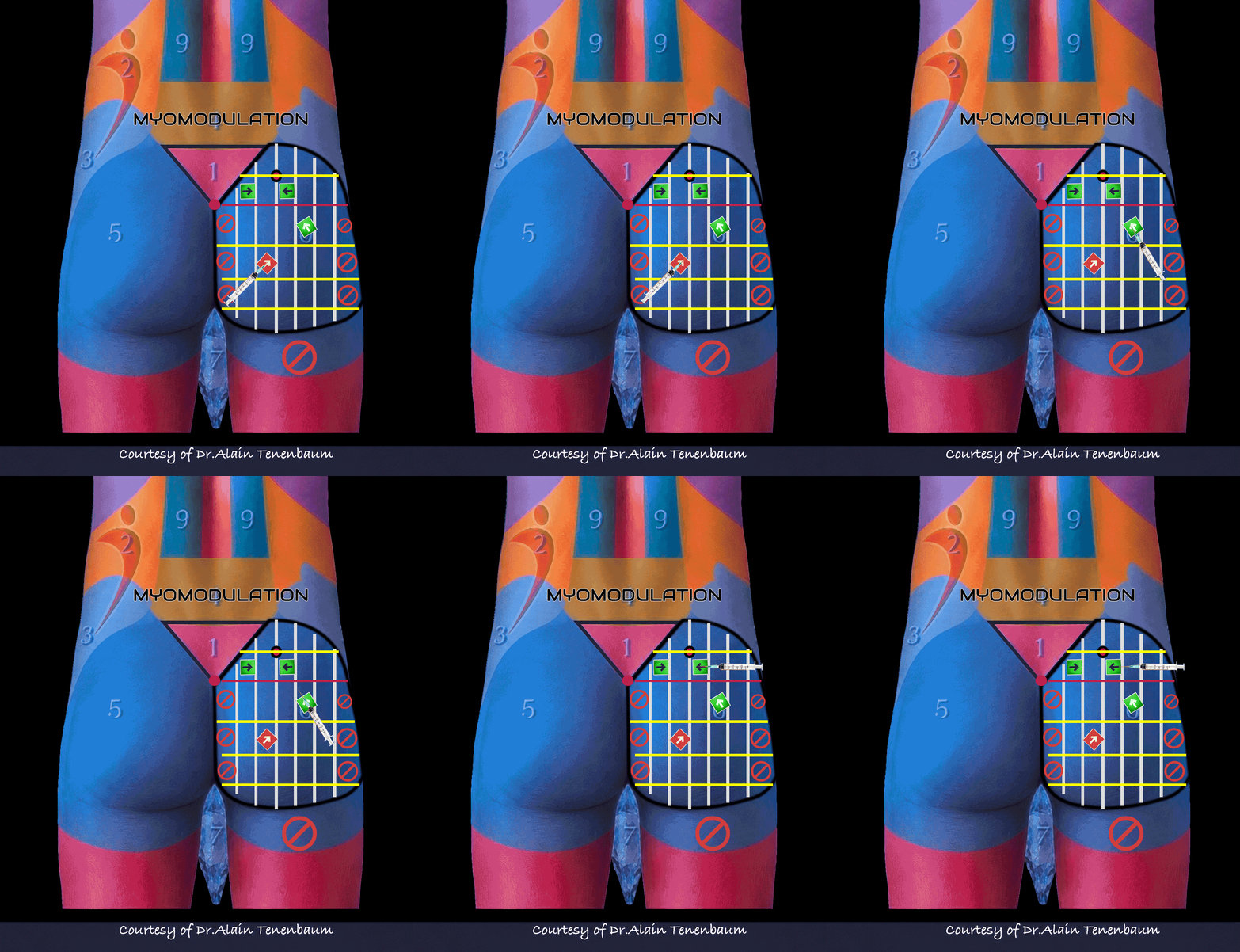
×
TENSOR APPLICATION
Animated clinical application of tensor injections in male gluteal Myomodulation
Tensor Design → Tensor Injection

The tensor component is translated separately according to the directional matrix planned for the same local territory.

VECTOR APPLICATION × TENSOR APPLICATION The clinical procedure preserves the same dual-component logic established during Vector–Tensor planning.
Global 3D Integration

Local Transformations Build the Global Shape

The final morphology emerges from the integration of the individual transformations distributed throughout the gluteal volume. This provides the conceptual basis for selective reshaping: lateral contour, projection, infragluteal architecture and intergluteal geometry do not need to change in the same way or to the same degree.

VOLUME → 3D UNITS → V × T → LOCAL 3D CHANGE → GLOBAL SHAPE
Target 1 · Selective Feminization

Lateral Contour “Latinization”

REDUCE THE HIP DIP. REORIENT THE LATERAL CONTOUR.

In this first feminization target, the objective is not to feminize the entire buttock. The intervention is concentrated on the external concavity, modifying the lateral contour while preserving anatomical territories the patient does not wish to change.

Male buttock Latinization planning showing the external lateral treatment territory
Target 1 — External Column / Lateral Concavity
Morphological Objective

Reduce the External Concavity

“Latinization” targets the lateral depression commonly perceived as the hip dip. The objective is to reduce this external concavity so that the lateral outline becomes straighter or more convex, according to the morphology requested by the patient.

THE TARGET IS LOCAL — NOT GLOBAL The lateral contour can be modified without automatically modifying the infragluteal area or the intergluteal cleft.
Initial Geometry
External Concavity / Hip Dip

The lateral outline presents an inward concavity that remains visible during relaxation and may become more evident during contraction.

→
Requested Geometry
Straighter or More Convex Lateral Contour

The selected external territory is reorganized to reduce the concavity and create a wider, more continuous lateral gluteal outline.

Tenenbaum–Tiziani Vector–Tensor Model

Latinization Is a Vector × Tensor Treatment

External Latinization does not result from tensor treatment alone. The selected lateral volumetric units are treated according to the complete Vector × Tensor model. The tensors receive the specific outward orientation required for Latinization, while the vectors within those same units are treated as well.

01
Select the Lateral Units

Identify the external volumetric units corresponding to the concave lateral territory that is to be modified.

02
Treat Vector & Tensor

Within every selected unit, both components of the local Vector × Tensor treatment are performed.

03
Orient the Latinization Tensors

The tensors of these external units receive the outward orientation required to reduce the lateral concavity.

Feminization-Specific Territory

Reading the Blue T-Arrows

In the blue diagrams, the visible T-arrows specifically represent the tensors used for external Latinization. Their outward orientation shows how the tensor component is modified within the selected lateral volumetric units to reduce the external concavity.

IMPORTANT
The T-arrows illustrate the Latinization tensors only. They do not mean that these volumetric units are treated by tensors alone. The vectors within the same units must also be treated according to the Tenenbaum–Tiziani Vector–Tensor model.
SELECTED LATERAL UNIT → VECTOR × LATINIZATION TENSOR → LOCAL LATERAL TRANSFORMATION
External Latinization tensor planning showing outward T-arrows in selected lateral male gluteal volumetric units
T-Arrows = External Latinization Tensors — Vector Treatment Is Also Performed Within the Same Volumetric Units
W↑
LATINIZATION INCREASES WIDTH — PROJECTION MUST BE REBALANCED

Within the Tenenbaum–Tiziani model, the gluteal transformation is considered isovolumetric. If the product L × W × H remains constant, increasing lateral width (W) necessarily tends to reduce the anteroposterior dimension (H) — and therefore gluteal projection.

W ↑  →  H ↓  →  PROJECTION ↓

External Latinization therefore cannot be planned independently from projection. Once lateral width has been increased, projection must be reassessed and, when required, specifically restored.

Target 1 · Geometric Rebalancing

Projection Must Be Rebalanced

WIDTH AND PROJECTION ARE GEOMETRICALLY INTERDEPENDENT.

External Latinization increases lateral width. Within the Tenenbaum–Tiziani isovolumetric model, this change cannot be considered independently from projection: when width increases, the anteroposterior dimension tends to decrease.

01
Geometric Principle

The Isovolumetric Relationship

L × W × H
=
CONSTANT isovolumetric transformation

In this model, the three-dimensional gluteal volume is treated as an isovolumetric system. If the lateral dimension W — width increases while the volume remains constant, another spatial dimension must decrease. In external Latinization, this may be expressed clinically as a reduction in H — anteroposterior projection.

L Length Longitudinal dimension
W ↑ Width Increases External Latinization
H ↓ Projection Decreases Anteroposterior dimension
02 THE GEOMETRIC CONSEQUENCE
LATINIZATION W ↑

Lateral width increases

→
ISOVOLUMETRIC RESPONSE H ↓

Anteroposterior dimension decreases

→
MORPHOLOGICAL EFFECT Projection ↓

The buttock may become wider but flatter

03
Corrective Strategy

Create a Dedicated Projection Tensor

THE LOST PROJECTION CAN BE SPECIFICALLY REBALANCED.

When the increase in lateral width reduces the desired projection, an additional tensor can be created specifically to restore the anteroposterior dimension. This tensor is substantially larger than the small tensors used for local contour modulation.

LOCAL CONTOUR TENSOR
≈ 0.1 mL

Small local tensor used for focal contour transformation.

→
PROJECTION TENSOR
0.5–1.0 mL

Larger tensor created when projection requires substantial rebalancing.

DIFFERENT FUNCTION → DIFFERENT TENSOR MAGNITUDE

The objective is not simply to add volume. The larger tensor is positioned and oriented to recover the projection required by the new three-dimensional geometry.
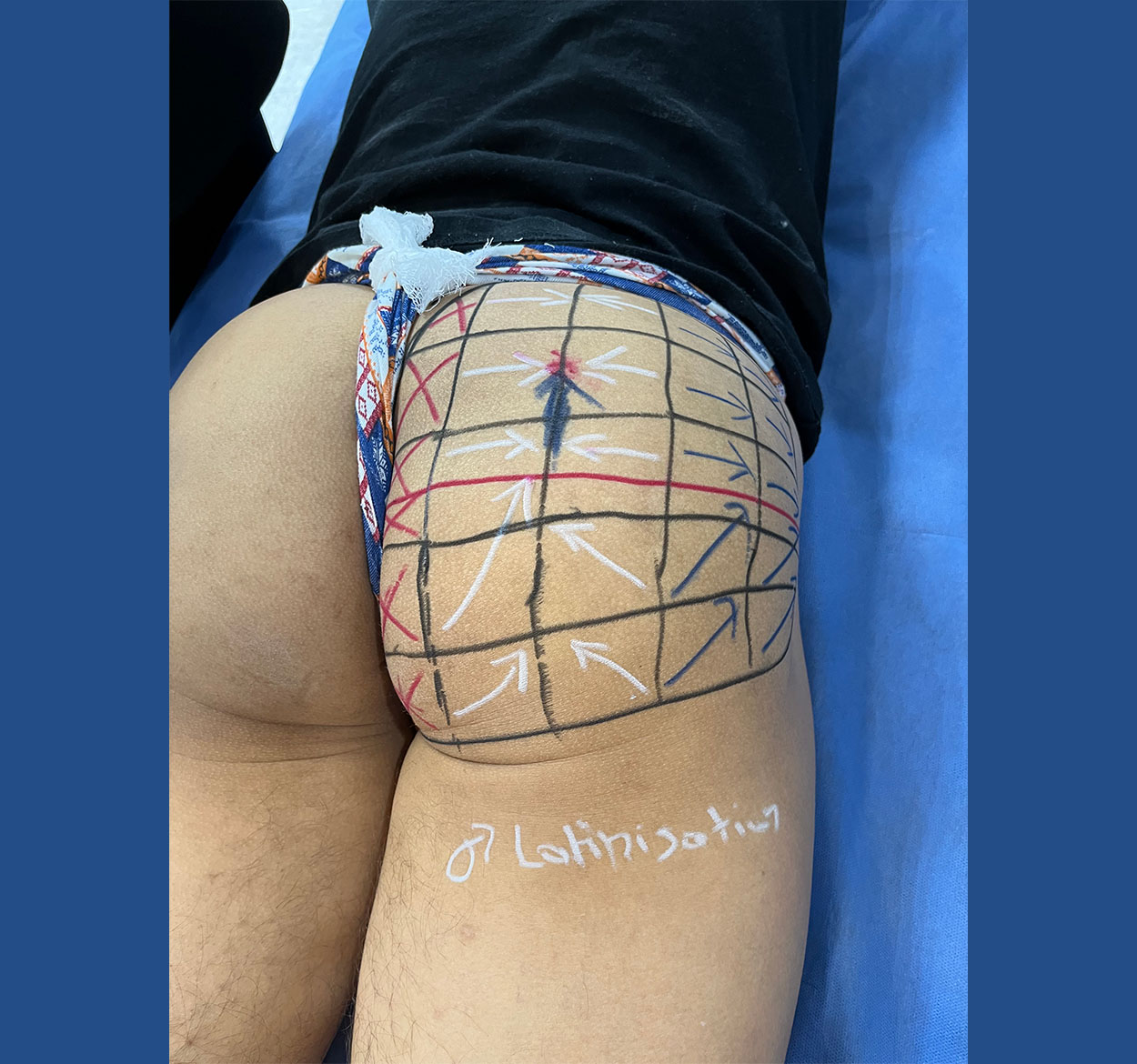
Projection tensor used to rebalance male buttock projection after external Latinization
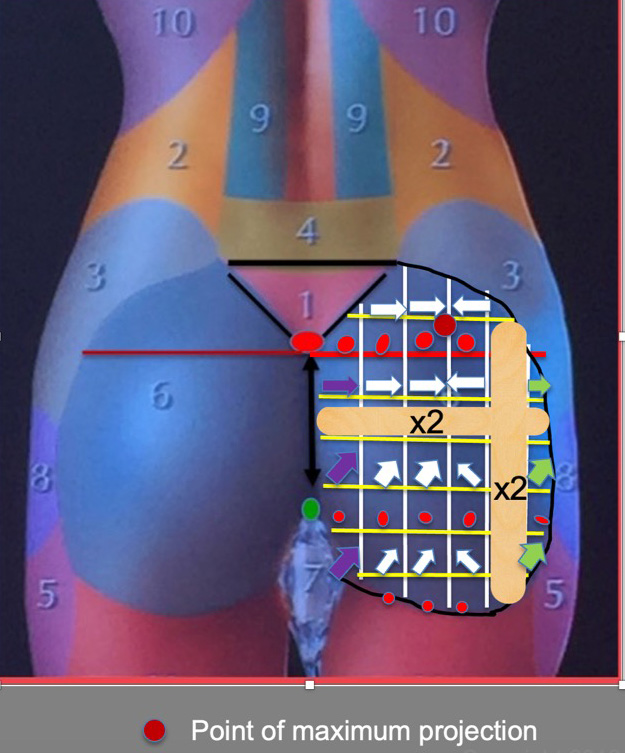
PROJECTION TENSOR The Large Green Arrow

The large green arrow represents the dedicated tensor used to increase projection toward the selected point of maximum projection.

04
Three-Dimensional Rebalancing

Width First. Projection Second.

01 External Latinization

Selected lateral volumetric units undergo their Vector × Tensor transformation.

→
02 Width Increases

External concavity is reduced and the lateral contour becomes straighter or more convex.

→
03 Projection Is Reassessed

The resulting anteroposterior dimension is evaluated within the new geometry.

→
04 Projection Is Rebalanced

When required, a dedicated larger tensor restores the intended point and degree of projection.

W ↑ → H ↓ → PROJECTION TENSOR → 3D REBALANCING

Latinization Is Not Simply Lateral Widening.

The final morphology results from the interaction between lateral contour and projection. Increasing width changes the geometry; projection is then selectively rebalanced when necessary to obtain the intended three-dimensional buttock shape.

Target 2 · Selective Feminization

Infragluteal Area

THE INFRAGLUTEAL FOLD AND THE AREA BELOW IT ARE TWO DIFFERENT TREATMENT TERRITORIES.

The infragluteal fold participates in buttock lifting and is treated as part of the lifting strategy. The infragluteal area located below that fold is different: in standard male buttock reshaping it is preserved, whereas it can become a specific treatment target when feminization of the lower gluteal contour is requested.

01
Essential Anatomical Distinction

Fold ≠ Area Below the Fold

INFRAGLUTEAL FOLD
LIFT

A Component of Buttock Lifting

Treatment of the infragluteal fold belongs to the lifting strategy of the buttock. It contributes to lifting but is not the only anatomical component responsible for the lift.

MALE OR FEMALE → PART OF THE LIFTING PLAN
INFRAGLUTEAL AREA
TARGET 2

The Territory Below the Fold

This is the lower gluteal territory extending beneath the infragluteal fold. Its treatment is a separate morphological decision and should not be confused with treatment of the fold itself.

BELOW THE FOLD → MORPHOLOGY-SPECIFIC DECISION
DO NOT CONFUSE LIFTING WITH FEMINIZATION

Treating the infragluteal fold for lifting does not mean that the infragluteal area below it has also been treated.

02
Sex-Specific Treatment Pattern

The Difference Is Below the Fold

Once the fold itself has been distinguished from the area below it, the treatment logic becomes very different according to the desired gluteal morphology.

STANDARD MALE PRESERVE

Do Not Treat the Infragluteal Area

In standard male buttock reshaping, the territory below the infragluteal fold is intentionally preserved.

INFRAGLUTEAL FOLD ✓ TREAT FOR LIFTING
AREA BELOW THE FOLD — PRESERVE
FEMALE MORPHOLOGY TREAT

Incorporate the Infragluteal Area

In female buttock reshaping, the area below the fold is generally incorporated into the treatment plan as part of the intended lower gluteal morphology.

INFRAGLUTEAL FOLD ✓ TREAT FOR LIFTING
AREA BELOW THE FOLD ✓ INCORPORATE
FEMINIZED MALE SELECT

Treat Only When Requested

In a male patient requesting feminization, the infragluteal area becomes an additional target only when the desired morphology includes this lower contour.

INFRAGLUTEAL FOLD ✓ TREAT FOR LIFTING
AREA BELOW THE FOLD ✓ IF FEMINIZATION REQUIRES IT
03
Clothing & Morphological Endpoint

The Jeans Test

LOWER GLUTEAL GEOMETRY CHANGES HOW THE BUTTOCK SITS WITHIN FEMALE-CUT JEANS.

One practical expression of this morphological difference can be seen with jeans. In female-cut jeans, the lower limit of the back-pocket geometry should remain related to the infragluteal fold rather than extending visually below the buttock into an untreated infragluteal area.

FEMALE-CUT JEANS → LOWER POCKET GEOMETRY → INFRAGLUTEAL FOLD
SELECTIVE MALE FEMINIZATION
Female Jeans or Lagerfeld-Type Styling

A male patient who wishes to wear female-cut jeans or a Lagerfeld-type silhouette may specifically request treatment of the infragluteal area. In this situation, the territory that is normally preserved in standard male reshaping becomes part of the feminization plan.
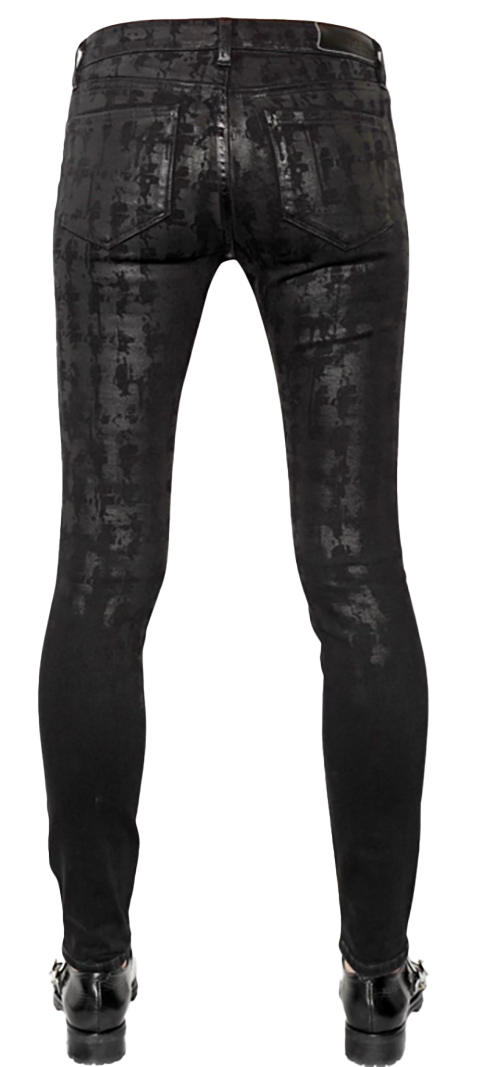
Male buttock feminization and infragluteal area in relation to female-cut jeans
TARGET 2 · LOWER GLUTEAL MORPHOLOGY The Infragluteal Area

In selected male feminization, the territory below the infragluteal fold can be incorporated into treatment when the desired contour is intended to work with female-cut or Lagerfeld-type jeans.

Clinical Planning

One Fold. Two Different Decisions.

START Infragluteal Fold

Is buttock lifting being performed?

→
LIFTING Treat the Fold

The fold participates in the global lifting strategy.

→
SEPARATE QUESTION Treat Below the Fold?

This depends on the requested lower gluteal morphology.

NO
Standard Male Morphology

Preserve the infragluteal area below the fold.

YES
Female or Feminized Morphology

Incorporate the infragluteal area into the treatment plan.

Patient-Defined Morphology

Feminization Remains Selective

A patient can request external Latinization while preserving the infragluteal area. Another patient can request both lateral feminization and modification below the fold. These are independent morphological choices.

TARGET 1 Lateral Contour External Latinization
TARGET 2 Infragluteal Area Area below the fold
TARGET 3 Intergluteal Cleft Separate morphological decision
THE KEY DISTINCTION

Treat the Fold for Lift. Treat Below It Only When the Morphology Requires It.

INFRAGLUTEAL FOLD LIFTING
≠
INFRAGLUTEAL AREA FEMINIZATION TARGET

In standard male buttock reshaping, the area below the fold is preserved. In female morphology — or in selected male feminization when a female-jeans lower contour is desired — that same area can become part of the treatment strategy.

Target 3 · Selective Feminization

Intergluteal Cleft Widening

THE INTERGLUTEAL CLEFT ITSELF IS NEVER TREATED.

Widening is produced indirectly by treating the medial gluteal column. Within its selected volumetric units, both vectors and tensors participate in the local transformation, while the tensors are oriented outward to reshape the medial contour of the buttock.

01
Fundamental Anatomical Principle

Treat the Buttock. Not the Cleft.

TREATED TERRITORY
M

Medial Gluteal Column

The actual treatment territory is the internal column of the buttock adjacent to the intergluteal cleft.

→
LOCAL TRANSFORMATION
V×T

Vector × Tensor

Both components are treated within the selected medial volumetric units.

→
INDIRECT EFFECT
↔

Wider Cleft

Outward transformation of the medial buttock contour increases the space between the two medial contours.

TREATMENT TERRITORY ≠ MORPHOLOGICAL EFFECT
MEDIAL GLUTEAL COLUMN → OUTWARD TRANSFORMATION → INTERGLUTEAL CLEFT WIDENING
Tenenbaum–Tiziani three-dimensional mapping of the medial gluteal column for indirect widening of the intergluteal cleft
TENENBAUM–TIZIANI TREATMENT MAP Medial Column Vector–Tensor Mapping

The cleft itself remains untreated. The mapping is applied to the medial gluteal column, where vectors and outward-oriented tensors reshape the medial buttock contour.

02
Reading the Clinical Map

The Image Shows Where We Act

The map separates the observed medial effect from the anatomical territory in which the Vector–Tensor treatment is performed.

REFERENCE Red Horizontal Line

A spatial reference used to organize treatment levels and tensor orientation.

TREATMENT TERRITORY Medial Gluteal Column

The internal column contains the selected volumetric units responsible for the medial transformation.

→
LOCAL TREATMENT Vector + Tensor

The selected units receive complete Vector–Tensor treatment rather than tensor treatment alone.

↗
DIRECTIONAL EFFECT Outward Orientation

Tensor orientation moves away from the intergluteal midline to reshape the medial gluteal contour.

THE CENTRAL RULE THE CLEFT IS THE RESULTING SPACE — NOT THE INJECTION TERRITORY.
03
Tenenbaum–Tiziani Vector–Tensor Model

Every Selected Unit Receives Vector × Tensor Treatment

Cleft widening is not produced by isolated tensor treatment. The medial gluteal volume is considered as a set of selected three-dimensional volumetric units. Within each treated unit, the vector and tensor together determine the local transformation.

V
FIRST COMPONENT Vector

The vector constitutes the first component of the local Vector–Tensor transformation.

×
T
DIRECTIONAL MATRIX Tensor

For intergluteal widening, the tensor is oriented outward within the selected medial volumetric unit.

=
3D
LOCAL RESULT Medial Reshaping

The local Vector × Tensor interaction changes the three-dimensional geometry of the medial gluteal column.

MEDIAL VOLUMETRIC UNIT → VECTOR × OUTWARD TENSOR → LOCAL 3D TRANSFORMATION
Tensor Direction

Different Orientations. One Outward Objective.

The tensor orientation can change according to its position within the medial column. What remains constant is its outward orientation away from the intergluteal midline.

↗
OUTWARD

Oblique

Oblique outward tensors can be selected according to the local geometry of the medial gluteal column.

→
ABOVE THE RED REFERENCE LINE

Horizontal

Above the horizontal red reference line, tensors can be directed horizontally toward the exterior.

↑
RARE

Vertical

Vertical tensor orientation can also be used, but remains comparatively uncommon within this strategy.

OBLIQUE + HORIZONTAL ABOVE THE RED LINE + VERTICAL · RARE → OUTWARD TENSOR ORIENTATION
Indirect Morphological Effect

How the Cleft Becomes Wider

The medial contour of each buttock contributes to the geometry of the space separating the two buttocks. When selected medial volumetric units are transformed outward, the internal gluteal contour is redistributed away from the midline.

The resulting increase in intergluteal width is therefore an indirect consequence of reshaping the buttock itself.

01 SELECT Medial gluteal units
→
02 TRANSFORM Vector × outward tensor
→
03 REORIENT Medial gluteal contour
→
04 WIDEN Intergluteal cleft
Patient-Defined Morphology

Cleft Widening Is Optional

A patient requesting male buttock feminization does not necessarily require modification of medial gluteal geometry. Target 3 is selected only when widening of the intergluteal cleft forms part of the desired morphology.

PRESERVE

Keep the Existing Cleft

The patient may request external Latinization and/or treatment of the infragluteal area while preserving the existing medial gluteal columns.

MEDIAL COLUMN → PRESERVED
TARGET 3

Widen the Cleft

When widening is requested, the medial gluteal columns are incorporated into the treatment plan using Vector × Tensor transformations with outward tensor orientation.

MEDIAL COLUMN → TREATED
Selective Male Buttock Feminization

Three Targets. Three Independent Decisions.

1
LATERAL External Latinization

Treat selected lateral volumetric units to reduce external concavity and reshape lateral contour.

2
INFERIOR Infragluteal Area

Treat the area below the infragluteal fold only when the requested feminization includes this lower territory.

3
MEDIAL Cleft Widening

Treat the medial gluteal column — never the cleft itself — when a wider intergluteal space is requested.

TARGET 3 · THE ESSENTIAL RULE

Never Treat the Cleft. Reshape the Medial Gluteal Column.

ANATOMICAL TARGET MEDIAL GLUTEAL COLUMN
→
LOCAL TREATMENT VECTOR × TENSOR
→
TENSOR DIRECTION OUTWARD
→
MORPHOLOGICAL RESULT WIDER CLEFT

The intergluteal cleft is the morphological result, not the treatment territory. Its widening results from the integration of local Vector × Tensor transformations performed within the medial gluteal column.

Clinical Planning · Selective Feminization

Clinical Planning & What Not to Change

THE PLAN IS DEFINED AS MUCH BY WHAT IS PRESERVED AS BY WHAT IS CHANGED.

Male buttock feminization does not require simultaneous modification of every gluteal feature. Clinical planning begins by defining the morphology requested by the patient, selecting the anatomical targets that should change, and deliberately preserving those that should not.

Male patient illustrating patient-defined clinical planning for selective buttock feminization
PATIENT-DEFINED MORPHOLOGY Analyze the Morphology — Then Decide What Should Change

Clinical planning separates the desired result into individual morphological components. Lateral contour, projection, infragluteal area and intergluteal geometry are assessed independently before deciding which features should change and which should be deliberately preserved.

01
Start With the Patient

Define the Desired Morphological Change

The objective is not to reproduce a predefined female buttock. The patient's aesthetic request is translated into a selective anatomical plan in which individual gluteal features can be modified, preserved or geometrically rebalanced.

NOT “How do we feminize the entire buttock?”
INSTEAD “Which features should change — and which should remain?”
SELECT What Changes
+
PRESERVE What Remains
=
RESULT Patient-Defined Morphology
Target Selection

Four Questions Before Treatment

Three anatomical regions can be selected as feminization targets. Projection is assessed separately as a three-dimensional variable that may require rebalancing when the surrounding geometry changes.

1
FEMINIZATION TARGET
LATERAL CONTOUR

Should the External Concavity Be Reduced?

When lateral Latinization is requested, selected lateral volumetric units receive complete Vector × Tensor treatment.

CHANGE OR PRESERVE
2
3D VARIABLE
PROJECTION

Does Projection Need to Be Rebalanced?

Projection is reassessed in relation to width and the resulting three-dimensional gluteal geometry. It is not an independent feminization target.

REASSESS AND REBALANCE
3
FEMINIZATION TARGET
INFRAGLUTEAL AREA

Should the Area Below the Fold Be Included?

The infragluteal fold participates in buttock lifting. Treatment of the area below the fold is a separate feminization decision.

INCLUDE OR PRESERVE
4
FEMINIZATION TARGET
INTERGLUTEAL GEOMETRY

Should the Intergluteal Cleft Become Wider?

When widening is requested, treatment is performed within the medial gluteal column. The intergluteal cleft itself is never treated.

WIDEN OR PRESERVE
The Preservation Principle

What Not to Change Is Part of the Treatment Plan

In selective feminization, an anatomical feature may remain unchanged because preservation has been deliberately chosen — not because it has been overlooked.

↔
LATERAL CONTOUR Preserve Masculine Lateral Geometry

If external Latinization is not requested, lateral morphology can remain intentionally masculine while another feminization target is treated.

↑
PROJECTION Preserve or Rebalance Projection

Projection is not increased automatically. It is reassessed according to the intended relationship between width, projection and global three-dimensional shape.

▬
INFRAGLUTEAL AREA Preserve the Area Below the Fold

When feminization of the inferior territory is not requested, the area below the infragluteal fold remains outside the feminization plan.

║
MEDIAL GEOMETRY Preserve the Existing Cleft Width

When cleft widening is not requested, the medial gluteal column is not selected as a feminization target.

PRESERVATION IS NOT ABSENCE OF TREATMENT PLANNING. IT IS AN ACTIVE MORPHOLOGICAL DECISION.
03
Selective Combination

The Same Buttock Does Not Require Every Target

The three feminization targets can be selected independently and combined according to the requested morphology. Projection is then reassessed within the resulting three-dimensional geometry.

EXAMPLE A Lateral Feminization
CHANGE Lateral Contour
REASSESS Projection
PRESERVE Infragluteal Area
PRESERVE Cleft Width
EXAMPLE B Lateral + Inferior Feminization
CHANGE Lateral Contour
REASSESS Projection
INCLUDE Infragluteal Area
PRESERVE Cleft Width
EXAMPLE C Multi-Target Feminization
CHANGE Lateral Contour
REBALANCE Projection
INCLUDE Infragluteal Area
WIDEN Intergluteal Cleft
Clinical Workflow

Select. Preserve. Rebalance.

Treatment planning moves from the patient's requested morphology to local anatomical decisions and finally back to the global three-dimensional buttock.

01
DEFINE Patient Request

Establish the desired morphological change.

→
02
SELECT Treatment Targets

Identify the anatomical territories that should change.

→
03
PRESERVE Unselected Features

Define explicitly what should remain unchanged.

→
04
REBALANCE Global 3D Geometry

Reassess projection and overall morphological harmony.

TENENBAUM–TIZIANI PLANNING PRINCIPLE

Do Not Feminize Everything. Feminize What the Patient Wants Changed.

Lateral contour, infragluteal area and medial gluteal geometry can be selected independently. Projection is reassessed as part of the global three-dimensional balance. Features outside the requested morphological objective are deliberately preserved.

CHANGE SELECTED TARGETS
+
PRESERVE UNSELECTED FEATURES
+
REASSESS 3D BALANCE
=
RESULT PATIENT-DEFINED MORPHOLOGY
Clinical Case · Selective Feminization

Clinical Case: Selective Male Buttock Feminization

ONE PATIENT. ONE SELECTED MORPHOLOGICAL CHANGE. NOT GLOBAL FEMINIZATION.

This clinical case illustrates how a patient-defined feminization request can be translated into a selective morphological change. Here, the principal objective is the lateral contour: reducing the external concavity while deliberately avoiding an unnecessary transformation of every gluteal feature.

01
Patient Request

Reduce the External Concavity

The selected objective was modification of the lateral gluteal contour, with reduction of the external concavity — or hip dip — and creation of a smoother, more continuous external silhouette.

SELECTED MORPHOLOGICAL TARGET Lateral contour / “Latinization”
02
Selective Planning

Change One Feature — Preserve the Others

Selected lateral volumetric units are reshaped within the Vector × Tensor framework. The objective is not to impose a complete female-pattern buttock, but to modify the requested lateral geometry while preserving non-selected features and reassessing the overall three-dimensional balance.

CHANGE External concavity and lateral contour.
PRESERVE Non-selected morphological features.
03 · Clinical Result

External Contour Transformation

The before-and-after comparison can be read geometrically. Reduction of the lateral concavity changes the external silhouette from a more vertical or indented contour toward a smoother and more laterally oriented contour.
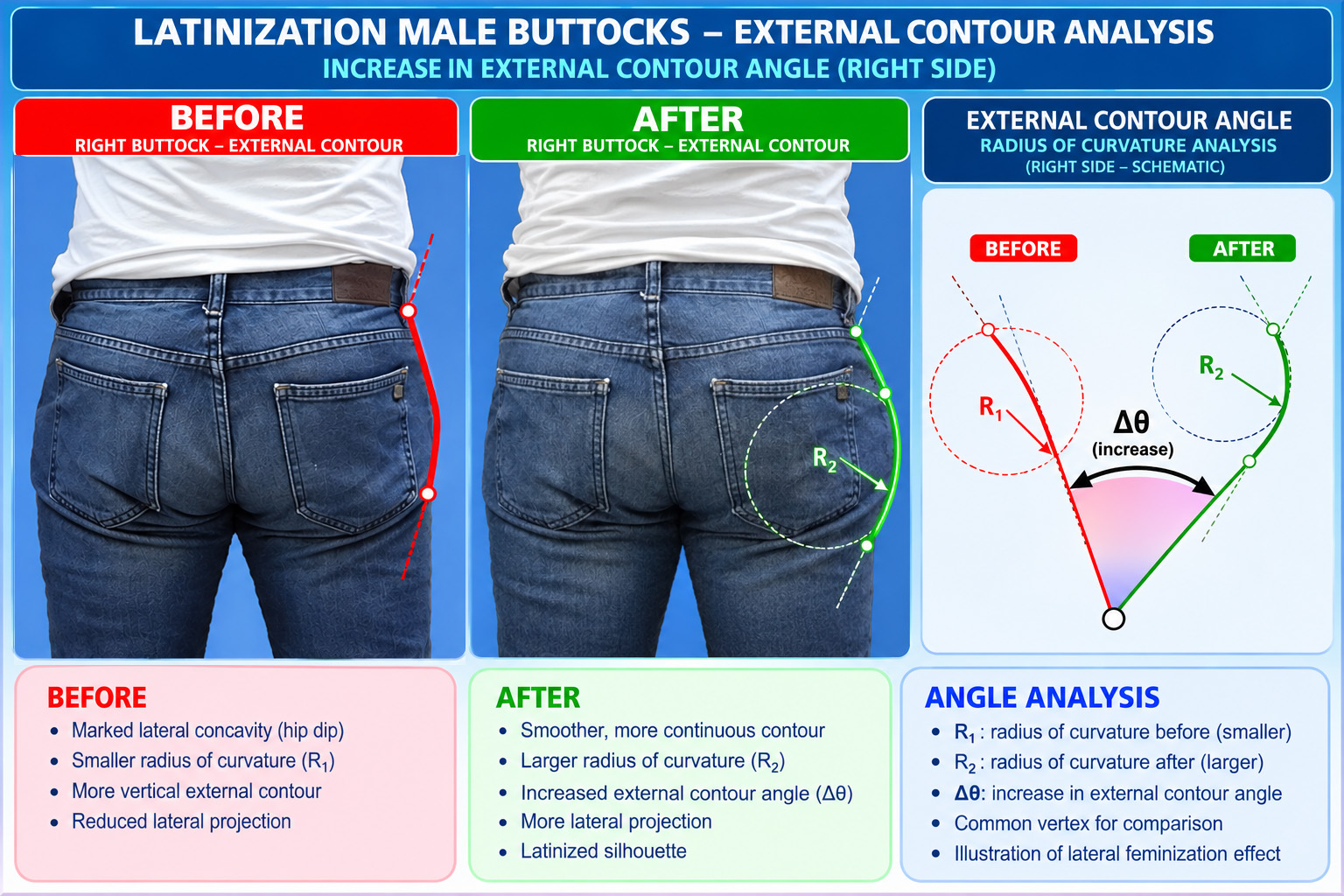
Male buttock Latinization before and after showing increased external contour angle
Morphological Analysis · Right Lateral Contour From External Concavity to a More Open Lateral Contour The red and green overlays provide a visual reading of the external contour before and after lateral reshaping. The schematic Δθ illustrates the increased opening of the lateral contour after Latinization. It is a morphological comparison, not a calibrated biometric angular measurement.
Before A marked external concavity creates a more indented and relatively vertical lateral silhouette.
After Reduction of the concavity produces a smoother and more laterally continuous external contour.
Δθ · Contour Opening The schematic angle expresses the increase in external contour opening produced by the morphological transformation.
04 · Dynamic Assessment

Relaxation & Contraction

The lateral contour can also be examined under different muscular conditions. Relaxation and contraction provide complementary views of the resulting morphology.

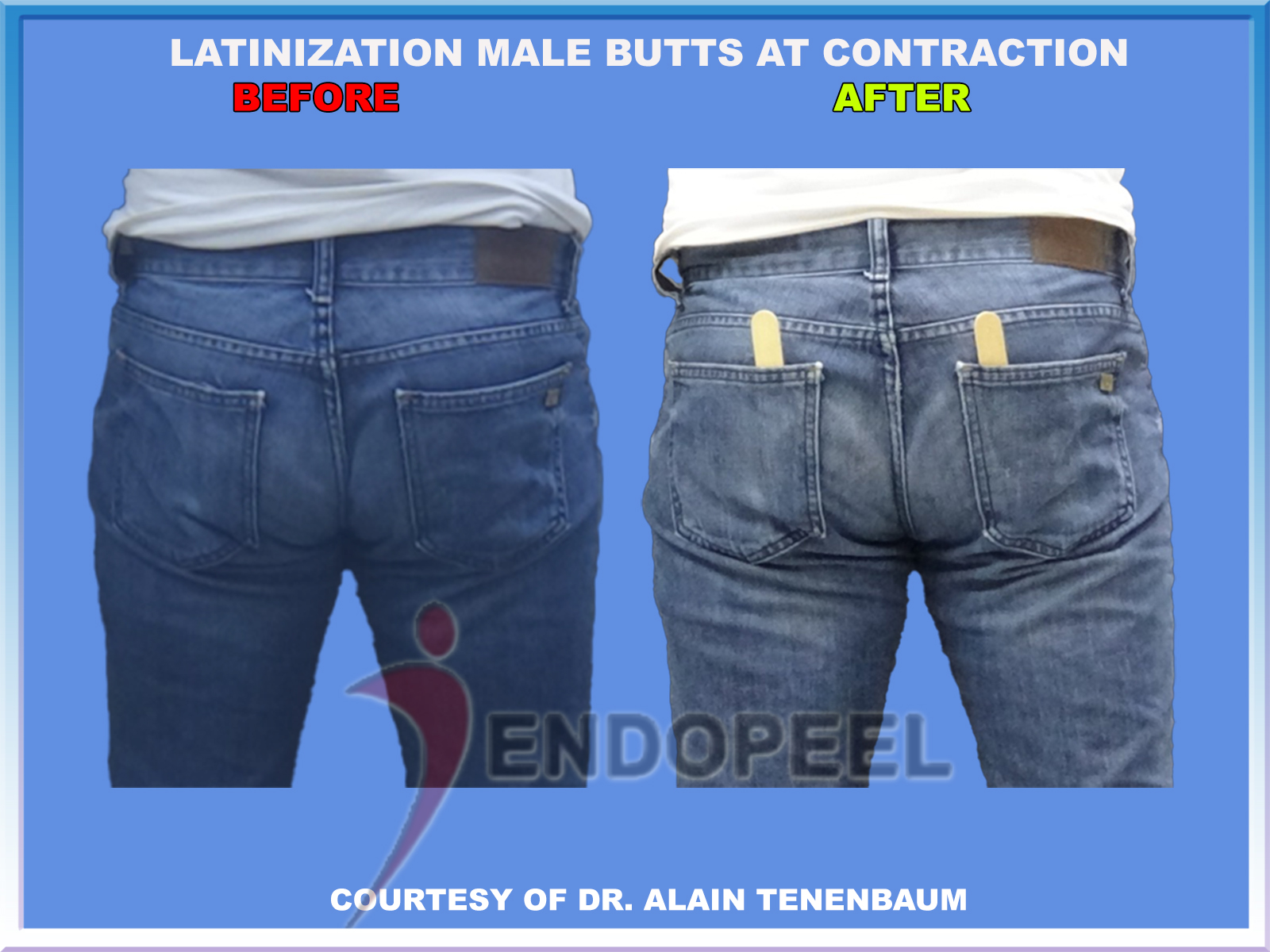
Tenenbaum–Tiziani Clinical Principle

The Result Comes From Selective Morphological Change — Not From Global Feminization.

This case demonstrates a lateral feminization objective rather than a requirement to feminize the entire buttock. The selected lateral morphology is changed, global three-dimensional balance is reassessed, and anatomical features outside the patient's selected objective can remain deliberately preserved.

Patient Request → Lateral Target → Vector × Tensor → Contour Change → 3D Reassessment → Selective Result
Clinical Integration · Male Gluteoplasty

Relationship to Male Gluteoplasty

THE FRAMEWORK REMAINS THE SAME. THE MORPHOLOGICAL OBJECTIVE CHANGES.

Selective male buttock feminization is not an isolated treatment system. Within the Tenenbaum–Tiziani Myomodulation® framework, it represents a different selection and orientation of local morphological transformations within the same three-dimensional gluteal architecture.
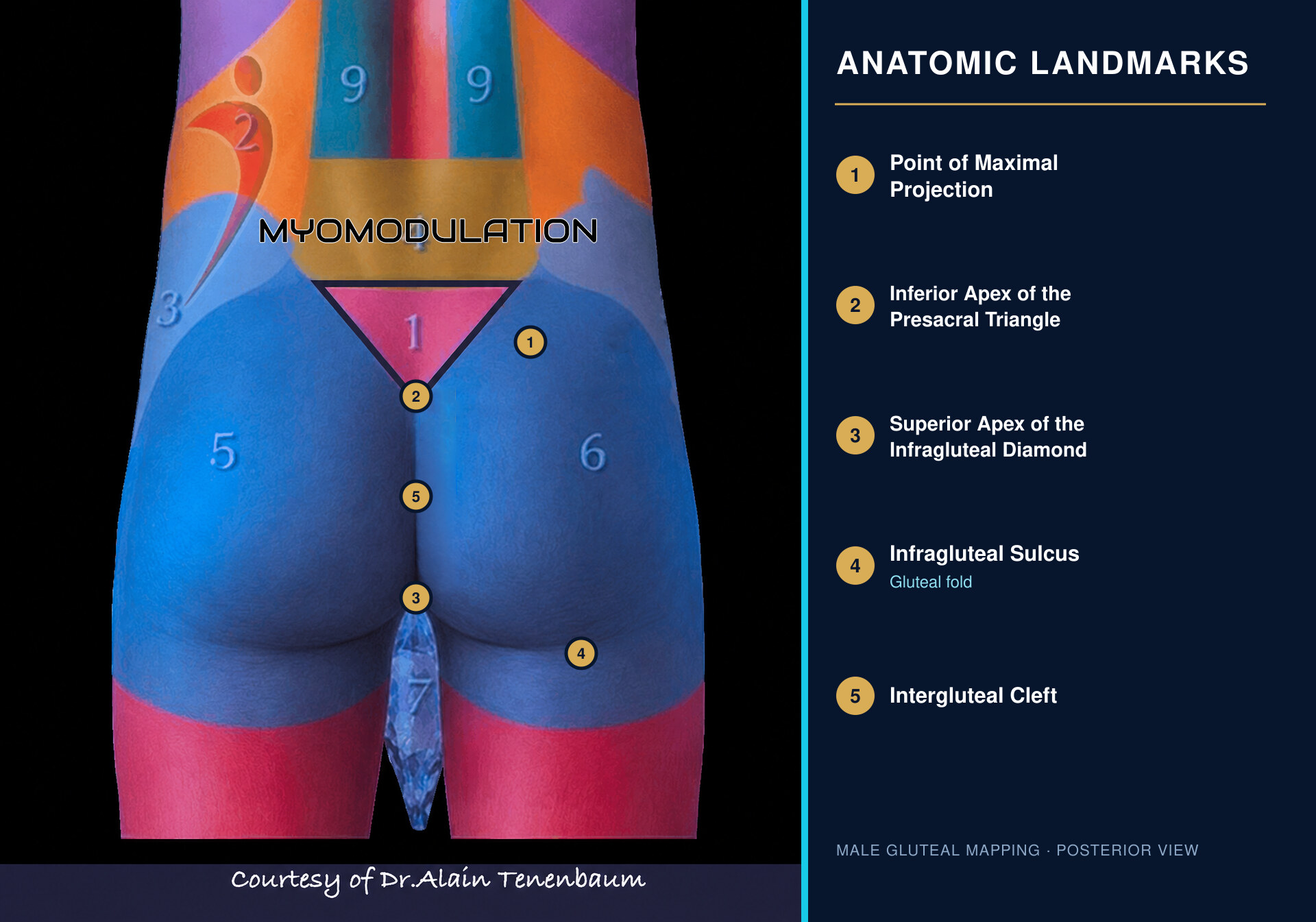
Male gluteoplasty anatomical landmarks for three-dimensional Myomodulation planning
Male Gluteoplasty · Anatomical Landmarks Male Gluteal Geometry
01 · The Common Foundation

Feminization Does Not Replace Male Gluteoplasty

Male gluteoplasty and selective male buttock feminization share the same underlying planning logic: gluteal morphology is analyzed three-dimensionally, selected anatomical units are identified, and local Vector × Tensor transformations are planned according to the desired global shape while preserving isovolumetry.

THE DIFFERENCE The distinction lies primarily in which morphological features are selected for change, how their local transformations are oriented, and which existing features are deliberately preserved.
02 · Same System · Different Morphological Objective

Male Pattern or Selective Feminization?

These are not two unrelated techniques. They represent different morphological planning pathways within the same Myomodulation® framework.

Masculine-Pattern Planning

Male Gluteoplasty

The treatment plan follows a masculine-pattern gluteal architecture, with its own distribution of treatment territories and three-dimensional contour objectives.

Male Geometry Vector × Tensor 3D Balance
Patient-Selected Feminization

Selective Feminization

One or more selected features can be redirected toward a more feminized morphology while other characteristics remain intentionally masculine or simply unchanged.

Lateral Contour Infragluteal Area Intergluteal Geometry
SHARED CORE Volumetric Units → Vector × Tensor → Local Transformation → Global 3D Shape
03 · What Actually Changes?

The Treatment Map Follows the Requested Morphology

The anatomical framework remains continuous. What changes is the selection of treatment territories and the orientation of the local transformations required to obtain the requested contour.

Variable 01 Territory Different volumetric units may be selected depending on whether the objective is masculine-pattern reshaping or selective feminization.
Variable 02 Orientation Local Vector × Tensor transformations are oriented according to the intended directional change of the selected morphology.
Variable 03 Preservation Anatomical features outside the patient's selected objective can remain unchanged rather than being incorporated automatically into a global feminization pattern.
04 · A Morphological Continuum

Not Two Boxes — A Patient-Defined Continuum

The clinical objective does not have to be classified as entirely masculine or entirely feminized. A patient may request preservation of most masculine-pattern characteristics while selecting one specific feature for feminization, or may request several feminizing changes within the same treatment framework.

Masculine-Pattern Gluteoplasty Selective Morphological Change Multi-Target Feminization
Tenenbaum–Tiziani Integration Principle Same Anatomy. Same Vector–Tensor Framework. Different Selection of Morphological Objectives.

Male gluteoplasty provides the broader three-dimensional treatment framework. Selective feminization modifies that planning only where the patient's requested morphology requires it.

Clinical Questions · Selective Male Buttock Feminization

Frequently Asked Questions

ONE FRAMEWORK. THREE SELECTIVE TARGETS. PATIENT-DEFINED MORPHOLOGY.

Male buttock feminization with Myomodulation® is not based on a standardized female template. The treatment plan is constructed from the individual morphological objective: which anatomical features should change, which should remain unchanged, and how the resulting three-dimensional geometry should be rebalanced while preserving isovolumetry.

The Essential Principle
SELECT · PRESERVE · REBALANCE

Select the requested morphological target. Preserve the anatomical features the patient does not want changed. Reassess the global three-dimensional shape after each planned transformation.

Lateral Contour Infragluteal Area Intergluteal Geometry
01 Does male buttock feminization mean making the entire buttock feminine?
No.

In this Myomodulation® approach, feminization is selective rather than global. A patient may request modification of the lateral contour while preserving the infragluteal area and intergluteal geometry, or may request another combination of morphological changes.

Feminization describes the direction of selected morphological changes — not a compulsory transformation of the entire buttock.
02 What are the principal morphological targets?

The planning model distinguishes three principal selective feminization targets:

01 Lateral Contour Reduction of the external concavity through selective lateral contour transformation.
02 Infragluteal Area Selective inclusion of the area below the infragluteal fold when required by the desired morphology.
03 Intergluteal Geometry Indirect modification of cleft width through treatment of the medial gluteal column.
03 Is projection a fourth feminization target?
No. Projection is a three-dimensional variable.

Projection must be reassessed whenever another component of gluteal geometry is modified. This is particularly important when lateral width is increased during Latinization.

WIDTH ↑ → 3D REASSESSMENT → PROJECTION REBALANCING

Projection therefore participates in global morphological balance but should not be confused with the three independent feminization targets.

04 Does Myomodulation® add volume to the buttock?
No. Myomodulation® is isovolumetric.

The objective is three-dimensional reshaping rather than volumization. Selected anatomical units undergo local Vector × Tensor transformations, and their integration produces the resulting global morphology while preserving isovolumetry.

MYOMODULATION® RESHAPES — IT DOES NOT ADD VOLUME.
05 What does “Latinization” mean in male buttock feminization?

Latinization refers here to selective modification of the lateral buttock contour, particularly reduction of the external concavity or “hip dip”.

The selected lateral anatomical units receive a complete Vector × Tensor treatment. The tensor component is specifically oriented outward to modify the lateral contour.

LATERAL UNIT → VECTOR × OUTWARD TENSOR → LATERAL TRANSFORMATION
06 Are the infragluteal fold and the infragluteal area the same target?
No. They must be distinguished.

Within this treatment framework, the infragluteal fold participates in lifting of the buttock. The area situated below the fold is a separate morphological territory.

In standard masculine-pattern treatment, this below-fold area is preserved. In selective feminization, it may be incorporated when the requested inferior contour requires it.

FOLD = LIFTING ARCHITECTURE · AREA BELOW FOLD = SELECTIVE FEMINIZATION TARGET
07 Is the intergluteal cleft injected to make it wider?
No. The intergluteal cleft itself is never treated.

When a wider cleft is part of the requested morphology, the treatment territory is the medial gluteal column. Selected medial anatomical units receive Vector × Tensor treatment with outward-oriented tensors.

MEDIAL GLUTEAL COLUMN → VECTOR × OUTWARD TENSOR → MEDIAL CONTOUR CHANGE → WIDER CLEFT

Cleft widening is therefore an indirect morphological result, not the consequence of treating the cleft itself.

08 Can only one feminization feature be changed?
Yes.

Selectivity is central to the planning concept. A patient may request only lateral Latinization, only modification of the infragluteal area, or only a change in intergluteal geometry. Several targets can also be combined when that corresponds to the desired morphology.

ONE TARGET · TWO TARGETS · THREE TARGETS — ACCORDING TO THE INDIVIDUAL MORPHOLOGICAL OBJECTIVE.
09 Is selective feminization a different technique from male gluteoplasty?
No. The underlying framework remains the same.

Male gluteoplasty and selective male buttock feminization use the same Myomodulation® planning logic. Gluteal morphology is analyzed three-dimensionally, selected anatomical units are identified, and local Vector × Tensor transformations are planned according to the desired global shape while preserving isovolumetry.

SAME ANATOMY · SAME VECTOR–TENSOR FRAMEWORK · DIFFERENT MORPHOLOGICAL OBJECTIVE.
10 What ultimately determines the treatment plan?

The treatment plan is determined by the requested morphology and the three-dimensional anatomical assessment — not by a predefined gender template.

Planning identifies which features should change, which should remain intentionally unchanged, and whether projection requires rebalancing after modification of the selected targets.

PATIENT REQUEST → SELECT → PRESERVE → REBALANCE → PATIENT-DEFINED MORPHOLOGY
THE CLINICAL LOGIC Do Not Feminize Everything. Feminize What the Patient Wants Changed.

Selective Myomodulation® combines patient-defined morphological objectives with three-dimensional anatomical planning and isovolumetric Vector × Tensor transformation.

Continue the Clinical Pathway

Related Clinical Resources

FROM SELECTIVE FEMINIZATION TO COMPLETE THREE-DIMENSIONAL GLUTEAL PLANNING.

Male buttock feminization is one application of a broader Myomodulation® framework. Continue with the anatomical, geometric and Vector × Tensor principles used to plan three-dimensional gluteal reshaping while preserving isovolumetry.

01 Anatomy
+

Gluteal Anatomy & Landmarks

Review the anatomical reference points and fundamental geometric principles used to organize the male buttock into clinically meaningful territories before planning morphological transformation.

MAP BEFORE TRANSFORMING
Explore Fundamental Basics
02 Vector × Tensor
×

Gluteal Vectors & Tensors

Continue into the Vector × Tensor framework used to organize local transformations within selected anatomical units and relate them to the resulting three-dimensional gluteal morphology.

LOCAL TRANSFORMATION → GLOBAL 3D SHAPE
Explore Vectors & Tensors
03 3D Geometry
↗

Projection & 3D Balance

Explore the fundamental geometric relationships between length, width, height and projection, and how global three-dimensional balance is reassessed when one component of gluteal morphology is modified.

RESHAPE · REASSESS · REBALANCE
Explore 3D Fundamentals
04 Clinical Application
◎

Clinical Cases & Morphological Results

Continue from theory to clinical application through examples illustrating how treatment objectives, selected anatomical territories and Vector × Tensor planning translate into morphological results.

PLAN → TRANSFORM → OBSERVE
Explore Clinical Applications
Scientific Framework Explore Myomodulation® Beyond Gluteoplasty

Continue to Myomodulation.com for the broader scientific, anatomical and clinical framework of isovolumetric Myomodulation®.

ANATOMICAL UNITS + VECTOR × TENSOR + ISOVOLUMETRY
Visit Myomodulation.com
Continue Exploring ONE ANATOMICAL FRAMEWORK. MULTIPLE MORPHOLOGICAL OBJECTIVES.
Male Gluteoplasty
Final Clinical Principle · Male Buttock Feminization

PROJECTION IS NOT VOLUME.

WHAT MATTERS IS NOT HOW MUCH VOLUME IS ADDED — BUT HOW THE EXISTING TISSUE IS THREE-DIMENSIONALLY PROJECTED.

Within the Myomodulation® framework, projection and lifting are approached through three-dimensional reshaping of existing tissue. The transformation is isovolumetric: morphology changes without requiring additional volume simply to create greater projection.

The Essential Distinction
RESHAPE ≠ VOLUMIZE

A buttock can become more projected because its existing three-dimensional morphology has been reorganized. Greater projection therefore does not necessarily require greater volume.

SHAPE → PROJECTION → 3D BALANCE
01 Myomodulation®
↗

ISOVOLUMETRIC PROJECTION

CHANGE THE SHAPE — NOT THE VOLUME.

Selected anatomical units are reshaped through local Vector × Tensor transformations. Their integration modifies the global three-dimensional morphology while preserving isovolumetry.

Existing Tissue → 3D Reshaping → Projection ↑
MORPHOLOGICAL RESULT PROJECTION ↑ WITHOUT ADDED VOLUME
02 Volumetric Augmentation
+

ADDED VOLUME

ADDING MATERIAL ALSO ADDS MASS.

Fillers and other volumetric augmentation approaches create projection by introducing additional material. Added material contributes additional mass and therefore increases the gravitational load acting on the supporting tissues.

Added Material → Mass ↑ → Gravity Load ↑
MECHANICAL CONSEQUENCE MASS ↑ GRAVITATIONAL LOAD ↑
The Physical Principle Fg = m × g

MASS HAS A MECHANICAL CONSEQUENCE.

Gravitational force is proportional to mass. When additional material is introduced, mass increases and so does the gravitational force associated with that added mass.

Isovolumetric reshaping follows a fundamentally different mechanical strategy: projection is sought through redistribution of three-dimensional morphology rather than through the addition of material.

Projection · Lifting · Mechanical Load

MORE PROJECTION DOES NOT HAVE TO MEAN MORE WEIGHT.

This distinction is central to the Myomodulation® concept. The objective is to obtain the desired projection and lifting morphology through isovolumetric reshaping rather than relying on additional volume as the mechanism of projection.

01 ISOVOLUMETRY
→
02 3D RESHAPING
→
03 PROJECTION
→
04 LIFTING MORPHOLOGY
Tenenbaum–Tiziani Vector–Tensor Model FROM LOCAL TRANSFORMATION TO GLOBAL SHAPE.
01 Anatomical Units
→
02 Vector × Tensor
→
03 Isovolumetric Transformation
→
04 Global 3D Shape
01
SELECT What Should Change
02
PRESERVE What Should Remain
03
REBALANCE The Global 3D Shape
THE MYOMODULATION® PRINCIPLE

DO NOT CONFUSE PROJECTION WITH VOLUMIZATION.

The objective is not to make the buttock heavier. It is to reshape its existing three-dimensional morphology so that the desired projection and lifting effect can be obtained while preserving isovolumetry.

RESHAPE · PROJECT · REBALANCE WITHOUT ADDING VOLUME
SELECT · PRESERVE · REBALANCE · RESHAPE